


study at: Technion Azrieli school of continuing studies Course: UXR Partner: Nadya Morgenstern
Spoiler
We discovered that there was no need for the product we initially intended to build. And the target audience turned out to be different from the one we originally defined.
The Plan
Domain Research
-
What ADHD is.
-
Which tools and methods exist (literature review).
-
Whether these existing tools can be translated into an app.
Market Research
Which digital products currently use principles from existing approaches, such as CBT and COG-FUN, to help adolescents with ADHD?
Methods
-
Qualitative User Research.
-
Quantitative Validation Research.
Product
-
Product Recommendations
-
UX Design
Research Question
How might we improve time management for adolescents with ADHD in a way that equips them with tools for academic success and overall functioning?
Background
Nadya: I have ADHD and I take medication, but it doesn’t help as much anymore. In addition, I’m being treated with CBT, which is the main approach for adults with ADHD, and I’d like to learn and apply additional tools.
Anat: I have a son with partially diagnosed ADHD who doesn’t want to explore the underlying causes and is resistant to medication.
Qualitative User Research
Method
Semi-structured in-depth interviews (IDIs) with adolescents diagnosed with ADHD.
Modality
Phone
Zoom
Discord
Sample
n = 8
Ages 12–18
Data Collection
-
All interviews were recorded with informed consent (participants + guardians).
-
AI-based transcription was used.
-
PII was removed to ensure privacy.
Key Finding
100% of participants identified supportive relationships as the primary driver of academic success

Adolescents quoting
Guy: “I said that Shiko believes in me - he gave me a second chance. The teacher believes in me, I don’t want to disappoint him. When there are teachers who believe in you, you want to make them feel they’re right.”
Tal: “I’m already doing the most I can -
I just don’t want him (my dad) to tell me, ‘come sit for another hour.’”
Alex: “You just need to explain to me what projects there will be - and I’ll do everything on my own! With my mom! I need her.”
Implication
Misalignment between initial hypothesis (time management tools) and user needs triggered a research pivot.
Quantitative Validation Research
Research Expansion
Following qualitative insights, we expanded the study to include parents and validate patterns quantitatively
Survey Design
Included questions on parent-child feedback dynamics Example: “When you compliment your child, what do you emphasize more?”
Data Collection
Online survey (Base44)
Available in Heb, Eng, Rus
Ethics
Participation was voluntary with full informed consent
Sample
n = 25
11 adolescents with ADHD
14 parents of adolescents with ADHD
Base 44 Survey


AI-Generated Survey Prompt (Base44)
Survey Data

A ranking question designed to identify key drivers of persistence during study


Examining feedback dynamics, motivation, and parent-child friction
Key Findings

Parental Feedback Pattern
93% of parents provide positive feedback focused on effort.

Friction Point
65% of parents report daily conflicts around screen time and academic activities.
For an adolescent to be receptive to parental input on any topic, a strong parent–child relationship is the foundation -
everything else is secondary.
Revised Research Question
How might we help parents of adolescents with ADHD strengthen relationships and deliver more effective feedback?
Research Constraints
Due to time constraints, no qualitative parent research was conducted hypotheses were derived from findings and validated through secondary research.
Post-Pivot: Reframing the Problem and Defining New Hypotheses
Hypotheses (Post-Pivot)
-
Behavior change from parent training does not persist over time
-
Parents do not lack theoretical knowledge
-
Gap: translating knowledge into daily practice
-
Gap: lack of context-sensitive feedback guidance
-
Gap: limited long-term support
Literature Validation
-
Butler & Nisan (1986): task-focused feedback preserves intrinsic motivation
-
Mueller & Dweck (1998): effort-based praise increases persistence

Product Recommendations
Product Goal
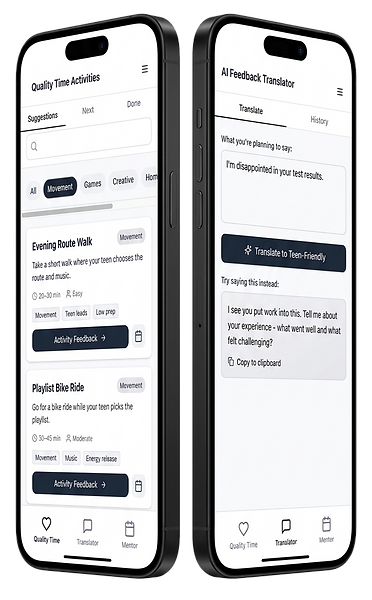
Support and strengthen parent–adolescent relationships in the context of ADHD
Design Principles
-
Prioritize relationship-building over symptom management
-
Provide contextual, accessible feedback guidance for parents
-
Bridge the gap between knowledge and daily implementation
Relationship building


Accessible Feedback Guidance


Permanent Mentor Support


Unique Contribution
Conceptual Shift
Adolescents seek meaningful human connection despite outward independence.
Identified Gap
-
struggle to translate it into daily practice
-
lack adaptive, process-oriented feedback
-
lack ongoing support
Product Direction
Integrated model combining:
-
professional guidance
-
AI-based daily translation
-
real-world home implementation
Research Limitations
What Didn’t Work
Survey questions lacked precision, made insights difficult to interpret
Key Issue
Ambiguity in wording (e.g., “meaningful feedback”) led to unclear data and reliance on assumptions
Limitations
Small sample size and course time constraints, limiting generalizability
Methodological Reflection
Future approach: start with in-depth parent interviews, then design a quantitative survey based on findings